
‘Unruly Unionism’ in Cold War America
 [1]
[1]In the March 5, 1957 issue of the UE NEWS, UE Washington Representative Russ Nixon reported that “a new broad attack of serious proportions is being launched against the entire labor movement.” The first item listed by Nixon in his outline of “this new anti-labor drive” was the “Select Committee on Improper Activities in the Labor or Management Field,” generally known as the McClellan Committee after its chair, Senator John McClellan, a right-wing Democrat from Arkansas.
Unlike previous Congressional investigations which had contributed to the near-destruction of UE and other militant unions, the McClellan Committee’s target was corruption, not so-called “communist domination.” There was, undeniably, corruption in the labor movement at the time, including in the Teamsters union, which was the main target of the McClellan Committee and its chief prosecutor, a young Robert F. Kennedy, fresh out of Harvard Law School. However, as UE’s General Executive Board warned in a statement issued in the next issue of the UE NEWS:
The purpose of the Senate labor investigation is to smear and discredit all labor and to prepare the way for further legislation in the line of the Taft-Hartley and Brownell-Butler Laws, to bring the labor movement another step on the road toward a labor front—a labor movement controlled by McCarthyite politicians for the benefit of Big Business.
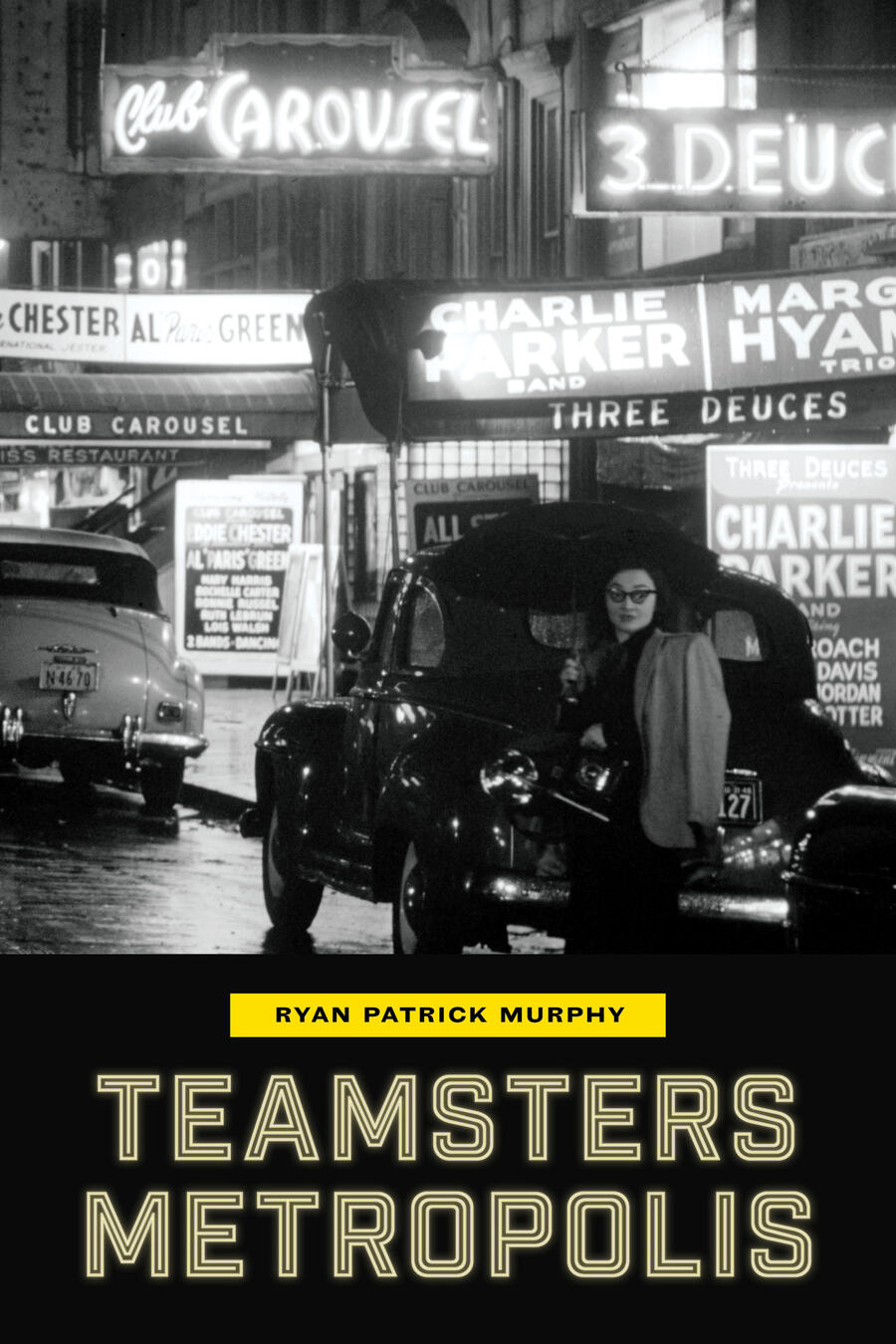
The McClellan hearings are the subject of the second chapter of a fascinating new book by historian and one-time UE activist Ryan Patrick Murphy. (While in graduate school at the University of Minnesota, Murphy was active in the 2004-05 UE campaign to organize graduate workers there.) In Teamsters Metropolis, he argues not only that the McClellan hearings targeted the Teamsters because they were, at the time, the fastest-growing union in the country, but also that the committee’s broader goal was “the regulation of working people’s bodies.” An historian of sexuality as well as labor, Murphy also finds in the history of the Teamsters a history of resistance to the work discipline and compulsory heterosexual monogamy that characterized Cold War America.
An Early “Union for Everyone”
Labor historians tend to be drawn to heroic stories, stories of rank-and-file workers righteously battling with greedy bosses, whether those battles end in triumphant victory or tragic loss. It is why UE and the International Longshore and Warehouse Union (ILWU) are among the most-studied unions in the American labor movement, and why the UE NEWS has in the past included articles on the history of other militant CIO unions like the Marine Cooks and Stewards [2], the Food, Tobacco and Allied Workers [3], and Mine, Mill [4].
However, most American workers have been, and remain, in unions that are full of contradictions. Many American unions have been democratic, militant, and/or progressive in some ways, while being bureaucratic, corrupt, and/or reactionary in others. There is value in studying the history of these unions as well. While Teamsters Metropolis has few clear heroes, it tells us a lot about how workers in mid-century America secured decent wages and union conditions in industries outside of basic manufacturing, maintained ties to their immigrant pasts, and protected their right to pleasure in the face of a culture that pushed workers to work ever harder for the boss’s profit.
The International Brotherhood of Teamsters grew faster than any other union in the 1950s, with a million workers joining the IBT over the course of that decade. Most of those workers were outside the union’s traditional jurisdiction of truck drivers, and by the time of the McClellan hearings, the Teamsters were a sort of “union for everyone,” encompassing workers in light manufacturing, warehousing, and a variety of retail and service industries. Teamsters members could be found in restaurants, bakeries, beauty salons, and liquor stores; they washed cars, maintained jukeboxes and pinball machines, and worked at dozens if not hundreds of other occupations.
Murphy writes that the union’s most dynamic organizer (and most infamous member), Jimmy Hoffa, who became the union’s general president in 1957, “recognized that while large-scale manufacturing was the core of the midwestern economy, hundreds of thousands of people still worked in mom-and-pop shops on every city block. The unceasing volatility of those small businesses was, in Hoffa’s mind, an organizing opportunity, one that would help him build a larger, stronger social movement that would touch people not just at work, but in the places where they washed their cars, bought their bread, drank their beer, and sang and danced after a hard day on the job.”
Hoffa’s success in pursuing this vision created what Murphy calls the “Teamsters Metropolis”: mid-century cities in which Teamsters union contracts allowed workers in these industries to move to “quiet, verdant, spacious suburban landscapes” like their counterparts in auto, steel, and electrical manufacturing, but also “[kept] them connected to the heterogeneous, tumultuous spaces of their parents’ and grandparents’ central city neighborhoods.”
Challenging Cold War Culture With “Unruly Unionism”
Murphy describes the mid-century Teamsters as a social and cultural movement that challenged “the suburban culture at the center of US Cold War planning.” That culture held that working people should work hard and obey their bosses at work, abandon any identification with their immigrant pasts, and live in monogamous, heterosexual nuclear families in single-family homes in the suburbs.
Although many Teamsters members did indeed move to the suburbs, they belonged to a union that practiced what Murphy calls “unruly unionism.” Teamsters leaders were big, brash, and loud, and often threatened bosses not just with pickets or strikes, but physical violence against their property or person. Organizing in industries that were characterized by lots of small shops, the Teamsters rarely relied on National Labor Relations Board elections, instead preferring to convince bosses through more direct means that it was in their best interest to recognize the union. Murphy quotes the testimony of a Teamsters local president during the McClellan hearings about an organizer he used to work with:
He would just walk into the shop and pull the switch and say “Everybody out on strike.” That is all there was to it. Everybody thought he was crazy and they would walk out and the boss would sign a contract. ... [H]e organized many shops by the same method.
Not only did the Teamsters’ unruliness threaten suburban decorum, the union’s culture also, according to Murphy, provided an alternative to the discipline of the work ethic. Following scholar Kathi Weeks, Murphy writes that “to remake the world in such a way that upends work’s discipline, workers must engage in living sensuous activity that produces physical gratification ... that is far more pleasurable than work.” In a chapter titled “Invested in Pleasure,” he reads Hoffa’s investment of union pension funds in hotels, retirement communities, and vacation homes for union members as just such “an antiwork political practice”:
Robust new Teamster contracts allowed rank-and-file union members to work less, shortening the work year with more weeks of paid vacation, and shortening the work life with a pension program that allowed workers to retire earlier. ... And by subsidizing sunny Miami afternoons under palm fronds that blew in the wind, Jimmy Hoffa’s Teamsters union incited pleasure, opening a space for living sensuous activity that rejuvenated the body rather than exhausting it.
Young Workers of Color Take On Union Racism
The contracts the Teamsters won in the 1950s provided access to middle-class incomes and lifestyles for a membership who were mostly eastern and southern European immigrants and their children. But not all Teamsters had access to the union’s “investment in pleasure.” By the end of the decade, many Teamsters locals had “signed collusive contracts with eastern and southern European small business owners that forced Black and Brown workers to pay union dues while earning minimum wage, receiving no benefits, and working mandatory overtime without any pay.”
Murphy explores this darker side of the Teamsters in a chapter titled “What Are We Paying Dues For? Young Workers of Color Confront the Teamsters Metropolis.” Young Black and Latino workers arriving in the same cities where Hoffa had built his union, their confidence bolstered by the victories of the civil rights movement, sought the same access to power and pleasure that eastern and southern European immigrants had fought for earlier in the decade. But instead of joining the Teamsters union, they left it.
In the late 50s and early 60s, workers of color in urban areas across the country, fed up with collusive racist contracts, left the Teamsters and other do-nothing unions, often striking or threatening to strike if their boss did not end his relationship with the Teamsters and recognize another, more democratic union. (Although Murphy does not mention UE, many such workers leaving corrupt or do-nothing unions joined UE during this period, including the workers at M. Chasen & Sons in Irvington, NJ, who were members of Local 155 from 1963 until their shop closed last year [5].)
In New York City especially, Murphy writes, this led to “a new wave of union militancy,” including citywide strikes in the lamp, garment, and healthcare industries. As Murphy points out, the Teamsters’ embrace of racist collusion, although it provided money for the union’s coffers, was a strategic mistake. “Absent solidarity with the new generation, the Teamsters’ once-unstoppable expansion withered at the outset of a new decade, which compromised its ability to seize the revolutionary potential of the new social movements of the 1960s.”
Gender and Sexuality in the Teamsters Union
The final chapter of the book, “What If We Had Known About Sylvia Pagano?”, makes the argument that “[w]hile monogamous heterosexual marriage, the suburban single-family home, the husband breadwinner, and the dependent wife were ideals that distributed money and power to many rank-and-file Teamsters ... Jimmy Hoffa’s network of comrades and kin refused to conform to those expectations.”
Throughout the book, Murphy highlights a number of ways in which Teamsters and other union members in the 1950s used labor activism as a way to live outside of conventional heterosexual domesticity. In his epilogue he notes that underworld associates of the Teamsters provided capital for much of New York City’s gay nightlife establishments in the 1950s and 1960s, including the famous Stonewall Inn.
But it is Sylvia Pagano, the subject of the final chapter, who steals the show. Pagano was a skilled union organizer and confidant of Hoffa who served as one of the key links between the Teamsters and the various ethnic syndicates commonly referred to as “organized crime” or “the mob.” (Although beyond the scope of this review, Murphy’s book includes a fascinating and nuanced take on the Teamsters’ relationship with the underground economy.) This provided Pagano with an income and mobility that allowed her to live a rich, independent, cosmopolitan life as a single woman, an unusual feat at the time.
Drawing on transcripts of a bug that the FBI planted in her Detroit apartment, Murphy paints a picture of Pagano living in what he calls “queer domesticity.” In an era in which women were expected to be dependent on a husband and spend most of their time in the home, Pagano’s life was instead filled with friends, lovers, and business associates, whom she frequently entertained at her apartment. She was especially close to Hoffa’s wife, and the Hoffas often watched her son while she was traveling on the union’s behalf.
In the conclusion of the chapter, Murphy urges “today’s labor activists to revisit Sylvia Pagano and others who fall outside the conventional paradigms for historical representation, as the cultural complexity of their business enterprises, their political mobilization, their friendships, their intimacies, and their desires has much to teach us.”
“A newer, queerer understanding of labor’s past”
In his 1994 book Rainbow at Midnight: Labor and Culture in the 1940s, historian George Lipsitz makes the argument that the utopian impulses of the 1940s labor movement, once expressed openly through militant strike activity but suppressed during the Cold War, went “underground” into popular culture, informing everything from roller derby to rock and roll. Murphy does not reference Lipsitz’s book or argument, but it is easy to see his pleasure-seeking Teamsters as a similar manifestation of working-class rebellion in an era when explicitly political dissidence could result in blacklisting, deportation, or even jail time. Indeed, Robert F. Kennedy thought that the Teamsters were as much of a threat to the Cold War order as UE had been considered in the 1940s, titling his book about the McClellan hearings The Enemy Within: The McClellan Committee’s Crusade Against Jimmy Hoffa and Corrupt Labor Unions.
Murphy is making an historical argument about working-class culture, and such arguments are always difficult to prove conclusively, especially when they concern private matters such as sexuality. He writes that Teamsters activists in the 1950s and 60s “struggled over the meaning of their race, gender, sexuality, and class even as they lacked the language to articulate those dilemmas.” Whether because they lacked the language or simply did not write their thoughts down, his subjects left few written records of what they thought, so reconstructing their worldview is as much a work of imagination as investigation.
And, it must be said, most of the “labor activists” profiled in Teamsters Metropolis are officials and operatives like Hoffa and Pagano. While the union clearly gave such individuals access to (often luxurious) suburban living while maintaining a connection to the culture of the center city, it is unclear to what degree rank-and-file members experienced their union in this way.
Still, Murphy’s efforts towards excavating “a newer, queerer understanding of labor’s past” demonstrate that cultural ideas about the supposed value of hard work, and about suburban heterosexual marriage as the only acceptable form of domestic arrangement, were challenged even in outwardly conservative institutions like the International Brotherhood of Teamsters.
At the end of the book, Murphy writes, “Hoffa and his peers recognized that for the overwhelming majority of workers, toil makes people’s bodies feel pain, hunger, anxiety, fear, and boredom. Labor activism had to be about reversing those negative sensations, which would allow workers to experience pleasure, safety, satiation, and contentment in their lives.”
Comparing the Teamsters with the gay bathhouses funded by their underworld associates, he notes that both “delivered fleeting pleasures in a painful world,” and concludes that, “That unruly endeavor, the commitment to providing gratification for marginal workers who found so little comfort in the mid-twentieth century, is the most enduring contribution of the International Brotherhood of Teamsters to the US labor movement.”
-
Teamsters Metropolis is published by the University of Michigan Press, and can be purchased as a paperback, hard cover, or e-book from their website [6].
 [7]
[7]