
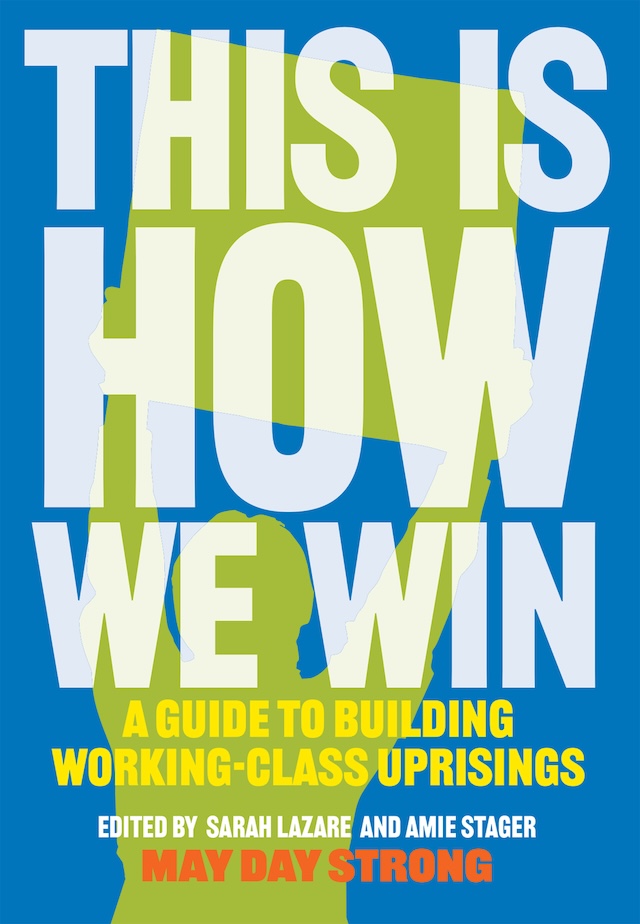
As the folk singer Ani DiFranco sings, “you gotta have the right tools for every job.” If the job is building a bolder, more militant labor and working-class movement, the May Day Strong coalition (of which UE is a part) has just produced an essential new tool. This Is How We Win: A Guide to Building Working-Class Uprisings is a slim collection of short essays, first-person accounts, and interviews which explore how working people can effectively use economic disruption to fight the billionaire class.
The story begins in Minnesota. The first part of the book, “They Did Not Account for Our Solidarity,” tells the story of how working people there responded to the Immigrations and Customs Enforcement (ICE) invasion of their state last winter. Union leaders, community organizers, and rank-and-file workers explain how ordinary Minnesotans took care of each other through mutual aid, confronted ICE agents attempting to kidnap their neighbors, and eventually organized a day of “no work, no school, no shopping” on January 23.
Spooked by the economic disruption of thousands of workers either convincing their employer to close for the day (as the members of UE Local 1105 did) or calling in sick, the CEOs of 60 Minnesota-based companies, including such giants as General Mills, Target, and Best Buy, released a letter calling for de-escalation, and the Trump administration began drawing down the ICE presence in the state by the end of the month. As SEIU Local 26 President Greg Nammacher writes, “The biggest lesson that we can learn ... is that we can win.” Nammacher emphasizes that his local’s participation in the day of economic disruption was made possible because they had regularly “exercised the muscle” of striking employers during contract negotiations when necessary.
The second section of the book, “The Power of Refusal,” looks at other successful examples of working people using large-scale economic disruption to confront entrenched power. Wol-san Liem from the Korean Confederation of Trade Unions describes the role that KCTU played in defeating an attempted coup in South Korea in December 2024. She notes that “It’s really important to recognize that union members and members of the public follow courage,” such as that of the KCTU militants who rushed to the National Assembly on the night of the coup to confront the coup forces. Journalist Matthew Cunningham-Cook reminds us that the North’s victory in the Civil War was due in large measure to the massive number of enslaved Black people who simply left their plantations, depriving the South of crucial labor necessary to produce food and raw materials. As he writes, “The Emancipation Proclamation issued by President Abraham Lincoln merely ratified a process already set in motion by the actions of a people fighting for their own freedom.” And Labor Notes and Substack writer Luis Feliz Leon writes about general strikes as cultural events, in which “That great mass of humanity that we today call workers can transition from being passive spectators into active protagonists, generating social movements and a demonstration of class power: workers versus bosses.”
The third and final section of the book, “Ferrying Each Other to Freedom,” examines what it will take to build a movement that is, in the words of Chicago Teachers Union and Illinois Federation of Teachers President Stacy Davis Gates, “about transforming a system that hoards wealth at the top, rewards bad behavior, and shuts too many people out of opportunity.” Gates (who spoke to the 2023 UE convention) uses examples from both her union and her family’s history to “clarify the important role of worker organizing in both helping each other survive and going on the offense.”
In the final essay, labor journalist Hamilton Nolan points out that every worker has the power to refuse to work, a power that cannot be taken away, even as bosses spend massive amounts of money and effort to convince us otherwise:
The power of solidarity has been wielded effectively by enslaved people, by penniless coal miners, by child laborers in mill towns. It has been wielded effectively by workers in steel factories and Amazon warehouses and prisons. People at the very bottom of society’s pyramid, people without money or connections or any other form of power, have used it to build a ladder to a better life. ... The billionaires, the company owners, the raving right-wing politicians — they know damn well that it works. That is why they work so hard to stop you from accessing it.
The book is less than 100 pages, with all of the chapters under 10 pages (and many just one or two); it is an easy read. The editors, Sarah Lazare and Amie Stager, have done an excellent job of keeping the text readable, in plain and accessible language.
In her essay, Gates invokes the example of the Black Pullman porters who took advantage of their jobs on the railroads — and significant risks — to distribute Black newspapers from northern cities like Baltimore and Chicago to Black families across the country, especially in the South. As she writes, “These newspapers helped Black families like mine imagine a better future.”
Like the Chicago Defender or the Baltimore Afro-American, This Is How We Win can help working people imagine — and fight for — a better life. So get a couple of copies, read one, and distribute the rest to your coworkers, your friends, your family — anyone who needs to be reminded of the power of solidarity.
- This Is How We Win is published by Haymarket Books and can be purchased on their website for just under $10.