General President Carl Rosen, who will retire in November after over four decades in UE, walked his first picket line at age five, when his father joined his fellow members of UE Local 1114 in a four-month strike at Goodman Manufacturing on Chicago’s south side. In college, Rosen spent his summers working at factory and warehouse jobs represented by the Steelworkers union and his time on campus helping organize the student movement against apartheid in South Africa. Following college, he got the training needed to be a maintenance electrician and returned to Chicago, where he “bounced around between different jobs that had lousy unions” and had to work “extremely large amounts of mandatory overtime,” Rosen told the UE NEWS.
Looking for a job where he could “work to live rather than live to work,” Rosen eventually hired on at Kerr Glass on Chicago’s Near West Side in 1984 and became a member of UE Local 190, which had kept alive many of the militant traditions of the Farm Equipment Workers (FE) union from which it originated. (FE merged into UE in 1949.) Rosen said it was “a real breath of fresh air to come into a UE shop … where you could actually know that the contract was enforced and was a strong contract.”
Rosen was recruited as a steward within his first year at Kerr, and over the next decade he served in multiple other positions in Local 190, from bargaining and grievance committee through local president. Kerr was “a very diverse shop,” Rosen said. “I learned a lot from a lot of people there in a lot of different ways” — especially about the importance of recruiting new leaders and ensuring that the leadership of the local represented the demographics of the membership.

UE NEWS photo from Local 190 negotiations in 1991.
In 1994, Rosen led a groundbreaking plant closing fight at Kerr, after the bosses announced their plans to move the plant to Tennessee. In addition to mobilizing the membership in Chicago, Local 190 took a delegation to a shareholders’ meeting in California, and filed labor board charges arguing that since the bosses had openly admitted they were moving in search of cheaper labor, they had a duty to bargain over the decision to close the plant. They won labor board support for a rare 10(j) injunction to stop the company from moving additional machinery without bargaining. By utilizing every piece of potential leverage they had, Local 190 was able to secure a strong plant closing and severance agreement, which included health coverage for life for workers 55 and over.
District and Regional Leader
In 1990, Rosen had been elected as the Secretary-Treasurer of UE District 11, which put him on the national union’s General Executive Board. In 1994 he was elected president of District 11, which covered members in Illinois, Wisconsin, Minnesota, and South Dakota. When the district merged into the larger UE Western Region in 2006, he was elected as the first UE Western Region President, with a turf now stretching from California to northwestern Ohio.
As district and then regional president, Rosen worked closely with UE Local 1111 at the Allen-Bradley plant in Milwaukee, historically one of UE’s most important shops. Local 1111 was an exemplary member-run local, Rosen said, and very serious about political action and being there for other workers’ fights. In the late 1990s, Rosen worked with Local 1111 President Bob Rudek in assisting UE Local 896-COGS, UE’s first graduate worker local, in figuring out how to best apply UE principles of rank-and-file democracy to this new type of workplace.
As District 11 President, Rosen also worked closely with Local 893-Iowa United Professionals. IUP was an independent union of state social workers in Iowa which had affiliated with UE in 1993, becoming the union’s first large public-sector local. Retired Local 893 President Bill Austin, who served with Rosen on the General Executive Board, said “Carl was really instrumental in getting me involved with the union on a larger scale.”
In 2008, Rosen served as the lead negotiator with major U.S. banks when the members of UE Local 1110 at Republic Windows and Doors occupied their plant, the first such action in many decades, which won them $2 million in severance. “I learned so many things from Carl Rosen,” Local 1110 President Armando Robles told the recent convention, adding that his local would get “a lot of support any time when we need it” from the regional president.
On the union’s General Executive Board, Rosen was known for his ability to get things done while maintaining unity. “Board members often leaned heavily on him, not only to ask the right question, but also to crunch the numbers or find a principled compromise when board members struggled to reach agreement on thornier issues,” said retired Director of Organization Bob Kingsley. Secretary-Treasurer Andrew Dinkelaker, who served as Eastern Region President prior to his election to national office in 2011, said, “I was always struck by his ability to ask the questions” that would move things along. “For a guy who has all the experience,” Dinkelaker added, “he still had an openness to new concepts or new things coming along.”

Rosen (right) with retired UE Director of Organization Ed Bruno (center) at the UE 72nd Convention in 2011.
“When the Western Region was formed in 2006, I was serving as Local 1421 President and District 10 Vice President,” said current Western Region President Bryan Martindale. “I had real concerns that California members might lose their voice in a region dominated by the Midwest. Carl personally made sure that never happened. He was intentional, thoughtful, and unwavering in his commitment to inclusive leadership.”
Elected General President
Rosen was elected UE General President in 2019, and helped lead UE through the Covid-19 pandemic, when the union had to quickly adjust to a new situation. Under Rosen’s leadership, UE quickly created new resources for locals to help keep their members safe. At a time when many unions simply abandoned democratic processes like meetings and conventions, Rosen was instrumental in figuring out how to maintain UE rank-and-file democracy using electronic communications and virtual meeting tools — including holding the union’s first-ever virtual convention in 2021.
As general president, Rosen also assisted with negotiating first contracts for two of UE’s new graduate worker locals, Local 256 at MIT and Local 1043 at Stanford. Both of these contracts were negotiated by large committees of rank-and-file members who took on much of the work themselves, and won by locals that were able to organize majority support for strike action if necessary.
“When our fight for our first contract began, many of us were daunted,” said Sophie Coppieters 't Wallant of Local 256. “Carl worked tirelessly alongside us, teaching and empowering us to organize and fight. He taught us that contracts are won not at the bargaining table, but across our workplace by organizing all of our coworkers. Carl’s decades of experience combined with his commitment to worker-led fights allowed us to win a first contract that set new standards across our industry.”

Rosen (on stairs, front right) giving a tour of the UE hall murals in Chicago to a large delegation from the militant Japanese labor federation Zenroren, 2010.
As district and regional president, and continuing as general president, Rosen maintained the UE hall in Chicago — the single biggest investment that the union had until it was sold in 2024. “I always enjoyed travelling out to UE hall in Chicago when Carl was regional president,” recounted Kingsley. “It was impressive how he had made UE’s headquarters on Ashland Avenue a true center of working-class political action in the nation’s third-largest city.” The hall was used not just by UE, but by a wide variety of other unions and community organizations that shared UE’s values. Rosen regularly hosted tours of its well-known murals, using them as an opportunity to tell the history of UE, the CIO, and the U.S. labor movement, including its interconnections with other movements for social justice.
“They all have tremendous respect for Carl”
In addition to working with UE locals, Rosen was a leader in UE’s coalition, international, and political action work. He represented UE on several international delegations, including to Brazil for the World Social Forum, to India to meet with the New Trade Union Initiative, to Japan to join Zenroren for a commemoration of the atomic bombing of Hiroshima, to Canada for multiple meetings with Unifor, and to Quebec for the most recent congress of the CCMM-CSN. He hosted many of UE’s international allies in Chicago, including helping several of them dedicate plaques on the Haymarket Memorial at annual May Day commemorations.
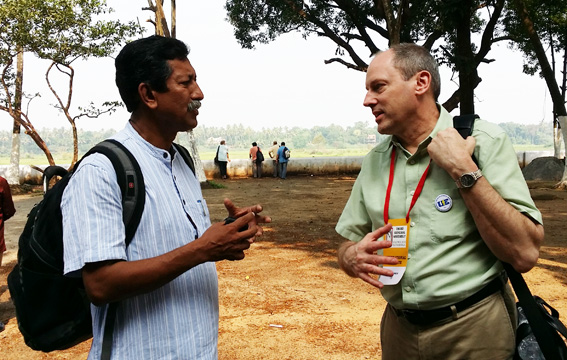
Rosen (right) with Ashim Roy, General Secretary of India’s New Trade Union Initiative, at NTUI’s Third General Assembly in 2014.
Michael Eisenscher, who worked for UE from 1972 to 1984 and served as the National Coordinator for U.S. Labor Against the War from 2003 to 2016, recalled that, “Carl and the UE played an important role in moving the labor movement into opposition to the Iraq/Afghan wars” in the early 2000s. More recently, Eisenscher worked with the UE president in organizing the National Labor Network for Ceasefire, in which Rosen “has played a pivotal role.” Eisenscher noted that at NLNC, Rosen has worked with “leaders of unions that have numerous locals larger than the entire national UE membership. But they all have tremendous respect for Carl, for his judgment, his leadership and ability to work across organizational and political boundaries.”
“Carl stepped into a lead role where there was a vacuum,” added Gene Bruskin, a long-time labor organizer who also worked with Rosen on NLNC. “No one wanted to be the boss and everyone was comfortable with Carl’s leadership. They respected him and he was masterful at including all the unions respectfully” in both meetings and one-on-one conversations. Bruskin also praised Rosen’s role in “shifting that whole group of unions and expanding into Labor for Democracy,” a coalition which brings together 15 national unions to move a fightback against the union-busting Trump administration.
“Embodies the principles this union was built on”
“During my over 40 years of membership in UE I've had the honor and privilege of working with a number of people totally dedicated to working for a better way of life for working people,” said retired UE General President John Hovis. “Whether fighting for a worker's grievance on the shop floor, leading difficult contract negotiations, fighting a plant closing or contributing to an organizing campaign, UE members could always count on Carl to be there fighting for justice.”
Rosen’s example of being “rooted in the shop … where the union actually lives” is “the antidote to what we see today which is an awful lot of superficial union leaders,” said retired Director of Organization Ed Bruno. “He was always there when you needed him, and he’s done very well,” said Karel Hoogenraad of UE Local 1139 in Minneapolis, who served as a National Trustee for many years. “Despite our differences over the years, we were always able to bring it out into one fight” against the boss.
“I have worked alongside Carl for two and a half decades,” said Director of Organization Mark Meinster (who, like Rosen, did not seek re-election, but will be returning to the UE staff). “More than anyone I’ve known, Carl embodies the principles this union was built on, and in my view he is the essence of what a militant, democratic union leader should be. He has an ironclad commitment to the working class, to democracy, to internationalism, to independent political action, and to working-class unity.”
Added retired UE President Bruce Klipple, “All of us who had the opportunity to work with Brother Rosen fully understand Carl may be retiring as an elected officer, but he will never retire from the ranks or pushing the labor movement to fight like hell for the workers!”